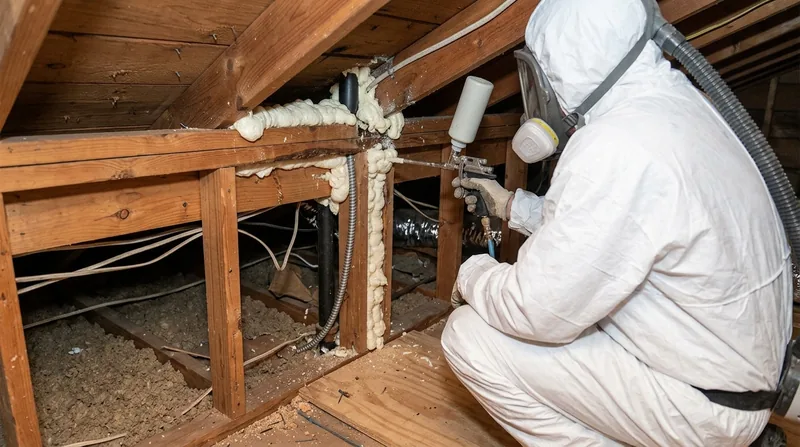




Columbus sits on the Chattahoochee River in a humid subtropical climate where hot, wet air pushes inward through walls, attics and crawl spaces for most of the year. Older homes in Midtown, Wynnton and Lakebottom, many raised on red clay with vented crawl spaces, let damp air settle into floor systems and rim joists. Mid-century ranch homes carry settled attic insulation and exposed ductwork that fight summer heat, while North side subdivisions built around Fort Moore growth run conventional vented attics with long duct runs and bonus rooms over garages. Across Muscogee County, the real energy cost comes from humid air moving through gaps in top plates, band joists and wall penetrations, working against your air conditioning all cooling season long. Air sealing in Columbus closes those gaps so conditioned air stays put, and the moisture that drives your utility bills stays outside where it belongs. We target the penetrations and thermal breaks that matter most in Muscogee County homes, and we pair air sealing with spray foam insulation to stop the leak at its source.
Why Air Sealing Matters in Columbus: The Humidity Problem That Costs You Money
Columbus heat and humidity are relentless from May through September, and air leaks make that problem worse. Humid outside air finds its way through unsealed top plates, electrical penetrations, and rim joist areas, then condenses on cooler interior surfaces where it feeds mold and rot. Your air conditioning runs longer to cool air that should never have entered the house in the first place. Sealing those gaps with spray foam stops the leak and protects the structure underneath, which is why air sealing is the foundation of any insulation retrofit in this climate.
- We identify and seal rim joist gaps where humid air enters floor systems in raised homes across Lakebottom and Wynnton.
- We close penetrations in attic top plates so conditioned air does not leak into unconditioned space above living areas.
- We seal band joist areas in basements and crawl spaces that pull in damp air and leave concrete slabs cold and clammy.
- We target electrical and plumbing penetrations in walls that let humid air move between conditioned and unconditioned zones.
Sealing these gaps is not optional in a humid climate like ours. It is the single biggest credibility differentiator between a spray foam shop that understands the climate and one that does not.
Key info: Homes in Columbus and LaGrange built before 1990 rarely have sealed attics or rim joists. The vented crawl spaces and open top plates that were standard then let humid air move freely through the building envelope, which is why so many older homes in this area have settled insulation, damp floors and high cooling bills. Air sealing fixes the root cause.
For more detail on how spray foam insulation works at the assembly level, see our closed cell spray foam page, which covers the R-value and thickness specs that seal the gaps we identify.
How We Perform Air Sealing in Columbus Homes: The Field Method
Air sealing starts with a walk-through of the attic, crawl space and rim joist areas to find where humid air is entering the house. We look for gaps at top plates, unsealed electrical boxes, plumbing penetrations, and band joist transitions. Once we map the leaks, we use low-pressure spray foam to seal each gap, filling voids without over-pressurizing the assembly. The foam cures to a solid, airtight seal that stops air movement and the moisture that travels with it.
- We inspect attics, crawl spaces and rim joist areas to identify air leaks and thermal breaks that let humid air enter.
- We seal top plates, electrical penetrations and plumbing stacks with low-pressure spray foam applied at controlled thickness.
- We use mechanical ventilation during cure to manage off-gassing and maintain a safe re-entry window of twenty-four to forty-eight hours.
- We provide a written estimate with R-value and thickness specifications so you know exactly what you are getting.
The result is a continuous air barrier that stops the humid air and the energy loss that comes with it. This is the foundation of any serious insulation retrofit in Columbus.
Local example: A 1970s ranch home in Columbus with an open rim joist and settled attic insulation will have humid air entering at the band joist and leaking out through the top plate. We seal the band joist with closed-cell foam, then top up the attic with open-cell foam. The result is a sealed envelope that stops the moisture and cuts cooling costs by eliminating the work your air conditioner should never have to do.
For details on the specific foam types and their R-values, visit our attic spray foam insulation page.
Air Sealing Methods: When to Use Spray Foam vs. Other Approaches
| Approach | Description | Best for |
|---|---|---|
| Closed-cell spray foam | High-density foam at 3.5 to 3.6 pounds per cubic foot, applied in thin passes to control depth and R-value per inch. | Rim joists, band joists, and rim board gaps where moisture control and structural integrity matter most. |
| Low-pressure spray foam | Lighter-density application used for sealing penetrations and top plates without over-filling cavities. | Electrical and plumbing penetrations in attics and walls where precision and safety during cure are critical. |
| Caulk and backer rod | Polyurethane caulk and foam backer rod for small gaps and seams where spray foam would be overkill. | Trim work, ductwork seams and minor air leaks that do not require structural insulation value. |
| Open-cell spray foam | Lower-density foam at 0.5 to 0.7 pounds per cubic foot, permeable to moisture vapor and suitable for interior walls. | Attic cavities and interior wall sections where air sealing and insulation value are both needed without moisture sensitivity. |
We choose the method based on the location, moisture exposure and the structural role of the gap. A rim joist in a humid crawl space calls for closed-cell foam. An electrical penetration in a dry attic calls for low-pressure application. The wrong choice leaves you with either inadequate sealing or unnecessary cost.
Air Sealing Cost in Columbus: What to Expect
Air sealing jobs in Columbus typically start at $650 for a small rim joist or attic penetration retrofit, and scale up based on the square footage of rim board, the number of penetrations, and the accessibility of the areas we are sealing. A mid-sized home with an open rim joist and multiple attic penetrations usually runs $1,200 to $2,500. Larger homes with extensive crawl spaces and complex attic layouts can run higher. The cost includes the spray foam, labor, mechanical ventilation during cure and a written estimate with R-value and thickness specs.
Factors that move the price up include the size of the rim joist area, the number of electrical and plumbing penetrations, crawl space height and access, and whether we are sealing an attic alone or combining it with insulation work. If your crawl space has standing water or the attic has active roof leaks, we address those first or we walk away. A wet substrate will not hold foam and will trap moisture underneath, which defeats the purpose.
We recommend getting 2 to 3 estimates from local contractors so you can compare scope, R-value specs and warranty terms. The cheapest estimate is often a red flag, especially if it does not include R-value or thickness in writing. Visit our pricing page for a detailed breakdown of what drives costs in your area.
Air Sealing Near Me: What Columbus Homeowners Should Know Before Hiring
When you are looking for an air sealing contractor in Columbus, the most important step is verifying that they are fully insured and that their insurance is current and covers spray foam work. Ask for a certificate of insurance and verify the coverage limits. Check references from recent jobs in your neighborhood, particularly homes built in the same era as yours, because the air sealing strategy for a 1970s ranch differs from a 2000s subdivision home. Ask the contractor for a written estimate that includes the R-value and thickness of the foam, the square footage of the areas being sealed, and the reentry window after cure. If the estimate is missing those details, ask for them in writing before you sign.
Understand what permits apply in Columbus. The building department may require a permit for attic work or rim joist sealing, depending on the scope. Ask the contractor to confirm with your local building department what applies at your address. If you live in a master-planned community or an HOA, check the architectural guidelines to see if any exterior work on crawl space vents or rim joists requires approval. Georgia law requires utility locates before any excavation, but air sealing work rarely involves digging, so do not let a contractor oversell that requirement.
Red flags include estimates with no R-value or thickness, promises of immediate reentry, prices far below market with no inspection, and insurance that cannot be verified. The contractor should be willing to answer questions about their equipment, their cure process and the mechanical ventilation they use during application. A local independent shop with a local address and local plates is often a better choice than a rig-and-run outfit from out of state, because you can reach them if a problem comes up after the job is done.
Ready to get started? Contact us for a free estimate. We respond within 24 hours at (706) 940-6925, and we can walk you through the entire process so you know exactly what to expect.
Air Sealing in Columbus: Pricing Guide
| Service | Price | Details |
|---|---|---|
| Small air seal (penetrations and gaps) | Starting at $650 | Attic penetrations, electrical boxes, and minor rim joist gaps in homes under 2,000 square feet |
| Mid-size rim joist and attic seal | $1,200 to $2,500 | Full rim board sealing plus attic top plate penetrations in typical Columbus homes, 2,000 to 3,500 square feet |
| Large or complex air sealing retrofit | On estimate | Extensive crawl spaces, multiple attic zones, or homes with prior moisture damage requiring substrate prep |
| Travel and setup | Included | No separate mileage or travel fee for Columbus and surrounding Muscogee County service areas |
| Written estimate with R-value and thickness | Free | Response within 24 hours, no obligation to book, full scope detail and specifications included |
Indicative pricing, the exact cost depends on square footage, finish, and site access. Free personalized estimate within 24h at (706) 940-6925.


