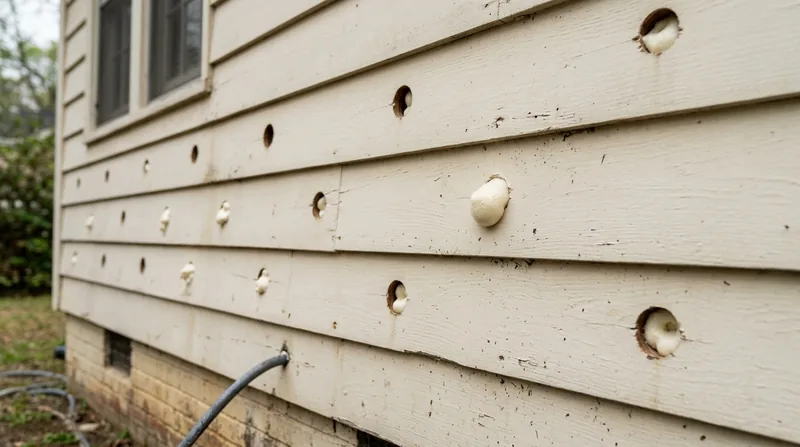




Older homes in Midtown, Wynnton, and Lakebottom Columbus were built with hollow wall cavities that sit exposed to the humid Chattahoochee Valley climate. Summer moisture pushes inward through uninsulated stud bays, settling at the dew point inside the walls and driving up cooling costs while leaving interior surfaces cold and damp. Wall and injection foam insulation fills those cavities without tearing out plaster or siding, sealing the thermal and moisture boundary from the inside out. We drill small access holes, inject closed-cell or open-cell foam to specification, and patch the exterior to match your existing siding. This approach works across the greater Columbus area, from the older neighborhoods near downtown to the mid-century ranch stock across Harris and Muscogee counties, and it restores the performance of homes that were never properly insulated in the first place.
Why Wall and Injection Foam Matters in Columbus Homes
The Chattahoochee Valley climate pushes humid air inward for most of the year, and uninsulated or under-insulated wall cavities are where that moisture condenses and settles. Pre-1980 homes throughout Columbus, LaGrange, and West Point were framed with wood studs spaced 16 inches on center, with no foam, no vapor barrier, and no thermal break between the interior and the outdoor air. Over decades, this means cold walls in winter, sweat and mildew in summer, and a continuous energy penalty as your HVAC system works against the thermal loss. Injection foam seals those cavities without demolition, adding R-value where it matters and stopping the moisture drive at the source.
- We drill access holes through the exterior siding or plaster at the stud bay, typically one hole per cavity.
- We inject closed-cell or open-cell foam at the manufacturer-specified ratio and pressure, filling the cavity completely.
- We patch the holes to match the existing siding color and texture, leaving no visible trace of the work.
- The foam cures hard in 24 to 48 hours, and the cavity is sealed against both air and moisture infiltration.
Once the foam is cured, the wall assembly functions as a true thermal and moisture barrier, stopping the seasonal energy penalty that has been running on your utility bill since the house was built.
Key info: A 1,200 square foot home in Columbus with uninsulated exterior walls (front, rear, and side elevations) typically runs 3,000 to 4,500 linear feet of cavity. That is the scope a contractor should be quoting, not a generic per-square-foot rate. We measure on site and provide a written estimate with R-value and thickness specs before we drill the first hole.
For more on how moisture and air infiltration drive energy loss in older homes, see our guide to air sealing in Columbus.
How We Inject Foam Into Columbus Walls: Process and Technique
Wall injection foam is a precision job, not a spray application. We work from the exterior, drilling small access holes into the stud bays, then injecting foam at controlled pressure and ratio. The goal is to fill the cavity completely without overpressure that can bow the wall or burst the plaster from the inside. We use a low-pressure injection system, monitor fill depth with a sight tube or depth gauge, and move to the next hole when the cavity is full. Timing matters: we inject in cool weather when the foam cures more slowly, giving us better control and fewer voids.
The process works on single-stud cavities, double-wall assemblies, and rim joists. It works on brick veneer, vinyl siding, wood siding, and stucco. The patch is the most visible part of the job, and we match color, texture, and finish to the existing exterior so the work blends in completely.
- We locate studs using a stud finder and mark access hole locations, typically 16 inches apart vertically.
- We drill a 1.5-inch hole through the siding or plaster, angling slightly downward to prevent water entry.
- We insert the injection nozzle and fill the cavity at 2 to 5 PSI, watching for foam to back out the top hole or overflow.
- We withdraw the nozzle, plug the hole with a foam backer rod, and patch with caulk or siding-matched filler.
- We verify the patch color and texture match the surrounding surface before we leave the site.
The entire process on a single wall section typically takes 4 to 8 hours, depending on cavity length, wall height, and siding type. Once the foam cures, the wall is sealed and insulated.
Example: A 1950s ranch in Columbus with 8-foot-high brick veneer exterior walls and 16-inch stud spacing requires about 24 access holes to cover the front elevation. We inject closed-cell foam at R-6.5 per inch, filling each cavity to the top plate. The job takes one day, and the brick veneer stays intact. No interior demolition, no exposed studs, no mess inside the house.
For comparison, see how rim joist and band joist insulation uses the same injection technique in basement rim areas.
| Approach | Description | Best for |
|---|---|---|
| Closed-Cell Injection Foam | High-density foam at R-6.5 per inch, fills cavity completely, acts as vapor barrier and air seal. | Exterior walls in humid climates, walls with moisture history, rim joists, band joists. |
| Open-Cell Injection Foam | Lower-density foam at R-3.5 per inch, vapor-permeable, lighter feel, easier to drill out if needed later. | Interior walls, sound dampening, retrofit where vapor permeability is desired, older homes with existing moisture management. |
| Rim and Band Joist Injection | Closed-cell foam injected horizontally into the rim cavity above the foundation, seals the thermal bridge. | Crawl space homes in Columbus, cold basement floors, energy loss at the rim, moisture infiltration at the band. |
| Retrofit Over Settled Insulation | Injection foam added to walls that already carry fiberglass or cellulose, upgrading R-value without removal. | Older attics with settled batts, walls with partial insulation, cost-conscious upgrades where demolition is not necessary. |
Wall and Injection Foam Insulation Cost in Columbus: What to Expect
Wall injection foam in Columbus typically starts at $2 to $3 per square foot of wall surface, depending on wall height, cavity depth, siding type, and foam density. A single-story elevation (front or rear) on a 1,200 square foot ranch runs roughly 1,200 to 1,500 linear feet of wall cavity, translating to an estimate in the $2,400 to $4,500 range for closed-cell foam. Open-cell foam runs 20 to 30 percent less because it is lower density and requires less material per cavity. The actual cost is always measured on site: we count studs, measure wall height, assess siding condition, and calculate the linear footage of cavity before we quote.
Factors that move the price up include brick veneer (slower drilling, more careful patch work), plaster walls (risk of cracking, more time on patch), multiple stories, and difficult access (scaffolding, roof work). Factors that move it down include vinyl siding (fast drilling and patching), single-story work, and open-cell foam when moisture control is less critical. Getting two or three estimates from local contractors is always smart because technique, foam cost, and labor rates vary.
See our full pricing overview for more detail on how we structure estimates and what is included in a written proposal.
Wall and Injection Foam Insulation Near Me: What Columbus Homeowners Should Know When Hiring
Hiring a spray foam contractor for wall injection work is straightforward if you know what to look for. First, verify that the contractor is fully insured and carries both general liability and completed operations coverage. Ask for a certificate of insurance and confirm the policy is active. Second, get a written estimate that includes the R-value of the foam, the thickness per cavity, the total linear footage of cavity, and the labor and material breakdown. Any estimate without those details is a red flag. Third, ask about the injection technique: low-pressure systems are safer and more controllable than high-pressure rigs, and a contractor who can explain the difference is one who knows the trade.
Fourth, verify that the contractor understands local permitting and building code. Wall insulation does not always require a permit in Columbus, but energy code upgrades sometimes do. The building official at your address is the final word, and a good contractor will defer to that office and help you navigate what applies. Fifth, if your home is in an HOA community with architectural restrictions, confirm that the contractor will work within those guidelines. Exterior work on walls can require approval, and injection foam itself usually does not, but the patch color and siding disturbance might. Ask before you book.
Finally, ask for references from recent jobs in Columbus or nearby towns, and call at least two. A contractor with a track record in the area and homeowners willing to vouch for the work is worth the extra due diligence. Call us at (706) 940-6925 for a free estimate with no obligation, and we will walk you through the process step by step.
Wall & Injection Foam Insulation in Columbus: Pricing Guide
| Service | Price | Details |
|---|---|---|
| Wall Injection Foam (Closed-Cell) | Starting at $2.50/sq ft | High-density closed-cell foam at R-6.5 per inch, fills cavity completely, acts as vapor barrier and air seal for exterior walls |
| Wall Injection Foam (Open-Cell) | Starting at $1.75/sq ft | Lower-density open-cell foam at R-3.5 per inch, vapor-permeable, ideal for interior walls and sound dampening retrofit applications |
| Rim and Band Joist Injection | Starting at $3/linear ft | Closed-cell foam injected horizontally into rim cavity above foundation, seals thermal bridge and stops moisture infiltration at band |
| Full-Home Wall Retrofit | On estimate | Multi-elevation job requiring site measurement of wall height, stud spacing, siding type, and total linear cavity footage before pricing |
| Travel and Setup | Included | No separate mileage charge or travel fee within Columbus and surrounding service area counties |
| Free Written Estimate | No charge | Detailed proposal with R-value, thickness specs, linear footage, and material and labor breakdown within 24 hours of contact |
Indicative pricing, the exact cost depends on square footage, finish, and site access. Free personalized estimate within 24h at (706) 940-6925.


