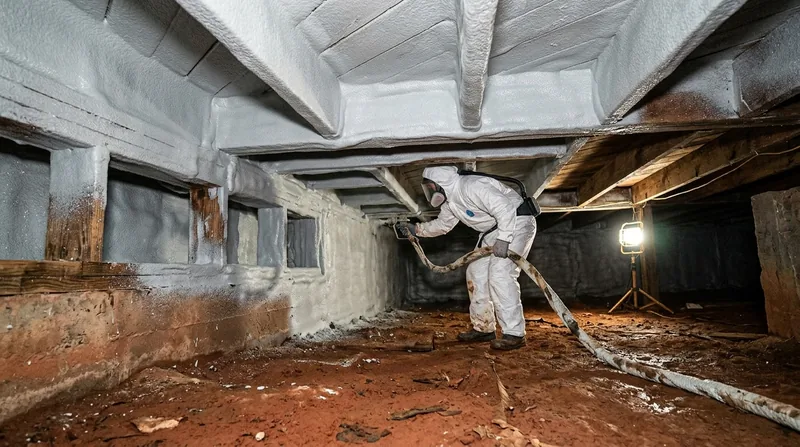




Closed cell spray foam insulation in Columbus creates a rigid moisture and air barrier that stands up to West Georgia humidity year-round. Columbus sits in IECC climate zone 3A, where hot summers and mild winters push humid air inward through vented crawl spaces, uninsulated rim joists, and metal buildings across Muscogee and Harris counties. Older homes in Midtown, Wynnton, and Lakebottom built on raised foundations over red clay pull damp air through vented openings. Mid-century ranch homes carry settled attic insulation that leaves roof decks running hot and ductwork exposed to summer heat. North side subdivisions near Fort Moore run newer slab foundations with conventional vented attics where moisture collects year-round. Closed cell foam seals these failure points with a continuous air and moisture barrier that works against the dominant climate pressure in this region.
Why Closed Cell Spray Foam Matters in Columbus Crawl Spaces and Metal Buildings
The biggest driver of energy bills in Columbus is the combination of hot attics and damp, vented crawl spaces working against each other for most of the year. Closed cell spray foam stops that cycle by sealing the crawl space walls and rim joists with a rigid, moisture-resistant barrier. Unlike open cell foam or fiberglass, closed cell does not absorb water and maintains its R-value even when humidity is high. Metal buildings and barndominiums across the area sweat and condense without closed cell protection, turning steel frames into rust factories. A sealed rim joist or crawl space wall means your floor system stays dry and your HVAC system doesn't fight vented humidity for eight months of the year.
- Closed cell foam resists moisture absorption and maintains R-value in high-humidity environments common to West Georgia.
- We seal rim joists and band joists to stop cold, damp floors in raised-foundation homes across Columbus neighborhoods.
- Metal buildings and barndominiums receive a continuous vapor barrier that prevents condensation and rust damage on steel framing.
- Crawl space walls sprayed with closed cell create a conditioned, dry foundation zone that reduces HVAC runtime during cooling season.
- The rigid foam does not settle or compress over time, so the air seal and R-value hold steady for decades.
These applications are the core reason closed cell exists: moisture control in spaces where water vapor is the dominant failure mode.
Key info: Columbus building code requires attic ventilation and ignition barriers for spray foam, governed by the energy code and building official at your address, never by us. Always verify what applies to your property with the local permitting office before any work begins.
For more detail on how closed cell compares to open cell spray foam, see our guide to open cell spray foam insulation.
How We Install Closed Cell Spray Foam in Columbus Homes and Commercial Buildings
Closed cell spray foam is mixed and sprayed in place, expanding to fill cavities and seal air leaks as it cures. We control thickness and density on every pass to meet code and deliver the R-value stated in the estimate. The job starts with a site assessment of the substrate, moisture conditions, and access. We set up mechanical ventilation during cure to manage odor and VOC off-gassing. Re-entry is safe after twenty-four to forty-eight hours, and the foam is fully cured in seven days. Every job receives a written estimate with R-value and thickness specifications so you know exactly what you are getting.
- We inspect the substrate for moisture, damage, or contamination; if the surface is wet or compromised, we walk away and fix it first.
- We set up containment and mechanical ventilation to control odor and ensure safe air quality during the spray and cure window.
- We spray closed cell foam in controlled passes, building thickness to the specification in your estimate, typically 1.5 to 3 inches for rim joists and crawl space walls.
- We allow twenty-four to forty-eight hours cure time before re-entry and confirm the foam has reached full strength before finishing work begins.
- We issue a final walkthrough report documenting coverage, thickness, and any trim or touch-up work completed.
This method ensures the foam bonds fully to the substrate and cures without voids or weak spots that could compromise the air seal.
Example: A LaGrange crawl space with vented rim joists and damp red clay floor receives 2 inches of closed cell sprayed to the band joist, sealing the band and rim in one pass and stopping air infiltration that was driving cold floors and high heating bills in winter months.
If your project involves existing insulation that needs to come out first, see our insulation removal service for details on safe, clean extraction.
Closed Cell Spray Foam Applications and Methods
| Application | Description | Best for |
|---|---|---|
| Rim and Band Joist Sealing | Closed cell sprayed 1.5 to 2 inches thick over rim joists and band boards, sealing air infiltration and stopping moisture entry into the rim cavity. | Raised-foundation homes in Columbus, Wynnton, and Lakebottom where cold floors and air leaks dominate winter comfort. |
| Crawl Space Wall Insulation | Closed cell applied to crawl space walls and headers, creating a continuous vapor barrier and conditioned foundation zone. | Vented crawl spaces with damp red clay floors; eliminates the need for active venting and reduces HVAC load during cooling season. |
| Metal Building and Barn Condensation Control | Closed cell sprayed to steel roof decks and walls, preventing condensation and rust damage on metal framing and fasteners. | Barndominiums, metal buildings, and agricultural structures across Muscogee and Harris counties where steel sweat and corrosion are constant risks. |
| Injection Foam Wall Retrofit | Closed cell injected into existing wall cavities through small access holes, no demolition required; typical density 2 to 2.5 pounds per cubic foot. | Pre-1980 stock and mid-century homes with hollow walls, eliminating the need to open walls and accelerating retrofit work. |
| Sealed Attic Roof Deck | Closed cell applied to the underside of roof decking, creating a conditioned attic and eliminating hot-roof and duct-loss problems. | North side subdivisions with bonus rooms and long duct runs; sealed attics reduce attic temperature by 15 to 25 degrees in summer. |
Closed Cell Spray Foam Insulation Cost in Columbus: What to Expect
Closed cell spray foam typically starts at $1.20 per board foot and ranges upward depending on substrate condition, access, thickness, and the size of the area being sealed. A 500-square-foot crawl space wall sealed with 2 inches of closed cell runs roughly 1,000 board feet and costs between $1,200 and $1,400 before any substrate prep or removal work. A rim joist job on a raised-foundation home in Wynnton or Lakebottom typically runs $1,500 to $2,500 depending on linear footage and foundation access. Metal building condensation control and sealed attic roof decks cost more per square foot because of the larger area and the equipment and ventilation required during cure. Every estimate includes R-value and thickness specifications so you can compare fairly across contractors.
The biggest cost variables are substrate condition, access difficulty, and whether existing insulation must be removed first. A wet crawl space or a roof deck with active leaks must be dried or repaired before foam is sprayed, and we walk away from those jobs rather than seal in moisture. A rim joist that is easy to access costs less than one requiring scaffolding or confined-space entry. Existing insulation removal adds $0.30 to $0.50 per board foot depending on the material and how densely it is packed. Getting 2 to 3 estimates from contractors in Columbus and surrounding areas is the best way to understand what your job should cost and to verify that each quote includes the same specifications.
For detailed pricing on specific applications and service areas, visit our pricing page. Call us at (706) 940-6925 for a free estimate with no obligation to book.
What to Look for When Hiring a Closed Cell Spray Foam Contractor Near Me in Columbus
Hiring a spray foam contractor is a decision that affects your home's comfort and energy bills for decades. The right contractor will provide a written estimate with R-value and thickness specs, show proof of insurance, and explain the cure time and re-entry window clearly. Bad installers work fast, quote no R-value, promise immediate re-entry, and disappear after the job. The local independent contractor with a local address and local plates is positioned differently than national franchises and rig-and-run crews: we know the Columbus building code, the local soil and moisture conditions, and the specific failure modes that plague homes in this area. Always verify any contractor's insurance status and ask for references from recent jobs in your neighborhood.
- Ask for a written estimate that specifies R-value, foam thickness in inches, and board-foot calculation so you can compare accurately.
- Verify insurance status and ask for a certificate of insurance naming your address; fully insured is the standard, bonding and licensing vary by city.
- Request references from at least two recent jobs in Columbus, LaGrange, or West Point and follow up with those homeowners about odor, cure time, and final quality.
- Confirm that the contractor uses mechanical ventilation during spray and cure, allows twenty-four to forty-eight hours before re-entry, and explains the odor profile honestly.
- Check that the estimate includes any substrate prep or removal work needed; if it does not, ask for a separate quote so you know the total cost upfront.
- Verify that permitting responsibility is clear; the contractor helps you navigate what applies at your address, but the city building department has final say on ventilation, barriers, and thermal requirements.
The strongest selling point of a local insulation shop is honest guidance: closed cell is the right choice for moisture-sensitive applications, but on a simple top-up of a sound attic, blown-in fiberglass is sometimes the right answer and a good contractor will say so.
Ready to get started? Contact us for a free estimate and to discuss your specific project.
Closed Cell Spray Foam Insulation in Columbus: Pricing Guide
| Service | Price | Details |
|---|---|---|
| Rim and Band Joist Sealing | Starting at $1.20/board ft | Typical job 600 to 1,200 board feet; cost rises with foundation access difficulty and linear footage of joist line |
| Crawl Space Wall Insulation | Starting at $1.20/board ft | 500 to 2,000 board feet depending on foundation size; substrate moisture and red clay floor conditions affect prep and total cost |
| Metal Building and Condensation Control | Starting at $1.20/board ft | Larger area and ventilation setup increase labor; steel roof decks and walls typically 2,000 to 5,000 board feet per building |
| Injection Foam Wall Retrofit | Starting at $1.20/board ft | Pre-1980 homes with hollow cavities; 400 to 1,500 board feet depending on wall area and cavity density; no demolition required |
| Substrate Removal and Prep | Starting at $0.30/board ft | Existing insulation extraction adds to total; wet or contaminated substrate requires drying or repair before foam application |
| Free Estimate | No charge | Response within 24 hours; (706) 940-6925; includes site assessment, specifications, and total cost with no obligation |
Indicative pricing, the exact cost depends on square footage, finish, and site access. Free personalized estimate within 24h at (706) 940-6925.


