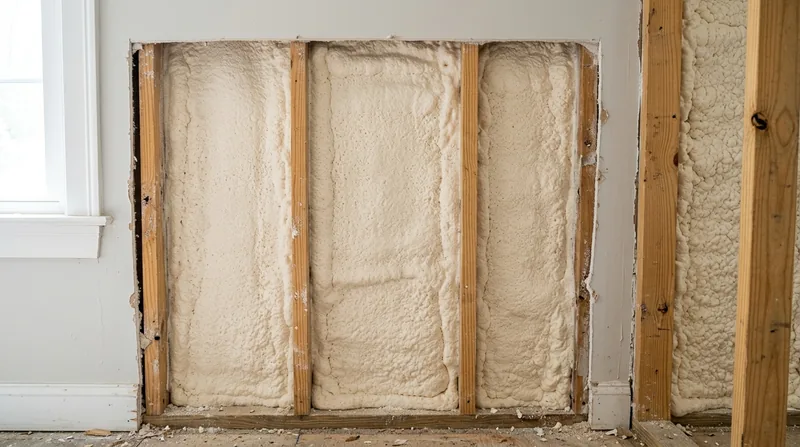




Open cell spray foam insulation in Columbus fills wall cavities and attic rafters with a lightweight, semi-rigid foam that cuts noise and slows heat transfer without the density of closed-cell alternatives. Columbus sits on the Chattahoochee River in IECC climate zone 3A, where hot humid summers and mild winters push moisture inward from outside for most of the year. Older sections of Midtown, Wynnton and Lakebottom hold early to mid-century homes, many raised on crawl spaces over red clay, with vented openings that pull in damp air and leave floor systems cold and clammy. Mid-century ranch stock across these neighborhoods often carries original attic insulation that has settled flat, so roof decks run hot and ductwork sits exposed to summer heat. Open cell foam works well in interior walls and conditioned spaces where the red clay foundations keep moisture moving through the structure, and it delivers the sound dampening that families near Fort Moore and in dense neighborhoods value. We help Columbus homeowners cut energy loss and improve comfort without the cost premium of closed-cell systems. Call us at (706) 940-6925 for a free written estimate with R-value and thickness specs.
Why Open Cell Spray Foam Matters in Columbus Homes
Columbus attics face a relentless challenge: exterior heat radiates through roof decks from May through September, and settled fiberglass insulation loses contact with the rafters, leaving gaps and air leaks. Open cell foam adheres directly to the underside of the roof deck and fills every cavity in one pass, blocking the air movement that fiberglass cannot. In the mid-century ranch homes that dominate the north side near Fort Moore, bonus rooms over garages and long duct runs fight attic temperatures through the long cooling season. Open cell foam also absorbs sound, a significant advantage in neighborhoods where aircraft noise and road traffic carry into living spaces.
- Open cell foam adheres to roof decks and fills cavities completely, eliminating the air gaps that settled fiberglass leaves behind.
- The material absorbs airborne sound, reducing noise from outside and between rooms, which matters in dense neighborhoods and near transportation corridors.
- Open cell foam costs less per board foot than closed-cell alternatives, making it a sensible choice for interior walls and conditioned attics where vapor drive is not the primary failure mode.
- The foam cures to a semi-rigid state that resists sagging and settling, holding its R-value for the life of the home.
These advantages make open cell foam the right choice for Columbus homeowners who prioritize comfort and cost-effectiveness over the maximum density of closed-cell systems.
Key info: Columbus attics with settled fiberglass insulation lose 20 to 40 percent of their insulating value as the material compacts and gaps form around ductwork and penetrations. Open cell foam fills these gaps in one pass and does not settle, maintaining its rated R-value indefinitely. Georgia Building Code and the International Energy Conservation Code govern attic ventilation and thermal barrier requirements at your address; always verify with the local building department before work begins.
For more detail on how open cell compares to closed-cell systems, see our guide to closed cell spray foam insulation in Columbus.
How We Install Open Cell Spray Foam Insulation in Columbus
Open cell spray foam installation begins with a site inspection to measure the area, identify penetrations, verify substrate condition, and confirm that moisture and ventilation issues are addressed before we spray. We prepare the space by protecting HVAC ducts, electrical boxes, and other fixtures with cardboard or tape. The foam is mixed to the correct ratio and drum temperature, then applied in thin, overlapping passes to build the specified thickness. Mechanical ventilation runs throughout the cure period, which typically lasts 24 to 48 hours, after which the space is safe for re-entry. We trim excess foam flush with the framing and leave the space ready for drywall, flooring, or whatever finish the homeowner has planned.
- We inspect the attic or wall cavity to measure square footage, identify obstructions, and confirm that the substrate is clean, dry and sound before we begin.
- We protect HVAC ductwork, electrical boxes, recessed lights and other fixtures with cardboard, tape or plastic sheeting to prevent overspray and damage.
- We mix the foam components to the manufacturer ratio and drum temperature, then apply in thin, controlled passes to achieve the specified R-value and thickness.
- We run mechanical ventilation during cure to manage VOCs and moisture, and we post a re-entry window of 24 to 48 hours before the space is occupied or finished.
- We trim excess foam flush with the framing, leaving a clean surface ready for drywall, insulation batts, or other finish materials.
This methodical approach ensures that the foam bonds properly, cures without defects, and delivers the R-value and air sealing that your home needs.
Example: A 1,200-square-foot attic in Wynnton with settled insulation and exposed ductwork receives 5.5 inches of open cell foam over the entire roof deck, yielding approximately R-19 to R-21 and complete air sealing of the attic-to-living-space boundary. The job takes one day for spray and cure, and the homeowner sees lower attic temperatures and quieter living spaces within the first cooling season.
Learn more about attic-specific work in our attic spray foam insulation service page.
Open Cell Spray Foam Installation Methods and Applications
| Approach | Description | Best For |
|---|---|---|
| Attic Roof Deck Spray | Foam applied to the underside of roof sheathing, creating a sealed roof deck that isolates living space from attic heat. | Mid-century ranch homes with settled insulation, bonus rooms over garages, and homes where attic ductwork runs exposed. |
| Wall Cavity Fill | Foam injected into wall cavities from the interior or exterior, filling gaps and cavities without removing drywall or siding. | Retrofit insulation of older walls in Midtown and Wynnton, new construction, and homes where cavity insulation is missing or incomplete. |
| Rim Joist and Band Joist Sealing | Foam applied to the rim board and band joist at the perimeter of the foundation, sealing the gap between the foundation wall and floor framing. | Crawl-space homes in Lakebottom and other low-lying areas where foundation moisture and cold floors are chronic problems. |
| Interior Wall Sound Dampening | Foam applied between studs in interior partition walls to absorb sound and reduce transmission between rooms and from exterior noise sources. | Homes near Fort Moore, dense neighborhoods, and any space where noise reduction is a priority, such as home offices or media rooms. |
Open Cell Spray Foam Insulation Cost in Columbus: What to Expect
Open cell spray foam typically starts at $0.55 per board foot, making it one of the most affordable spray foam options for attics and interior walls. The final cost depends on several factors: the square footage of the area being insulated, the desired R-value and thickness, the complexity of the space (obstructions, ductwork, electrical fixtures), and site access. A straightforward attic spray over a sound roof deck costs less than a retrofit wall cavity fill or a rim joist sealing project that requires detailed work around the foundation. Most Columbus homeowners spend between $1,500 and $4,000 for a full attic spray, depending on the home size and existing condition. We always provide a written estimate with R-value and thickness specifications so you know exactly what you are getting.
Getting 2 to 3 estimates from different contractors is smart practice. Compare the R-value, thickness, coverage area, and warranty terms, not just the bottom-line price. Avoid estimates with no specifications, no insurance verification, or promises of immediate re-entry; these are red flags for poor workmanship. Our estimates are free and carry no obligation to book. Call (706) 940-6925 to schedule yours, or visit our pricing page for more detail on what moves the cost up or down.
What to Look for When Hiring Open Cell Spray Foam Contractors Near Me in Columbus
Hiring the right spray foam contractor means checking three things: insurance and verification of coverage, a written estimate with R-value and thickness, and a clear understanding of the cure timeline and re-entry window. Ask any contractor to show proof of general liability and workers compensation insurance; this protects you if someone is injured on your property or if the work causes damage. Verify that the installer understands local code requirements for attic ventilation, thermal barriers, and ignition barriers, which are governed by the building official at your address, not by the contractor. Many Columbus homeowners fall victim to rig-and-run crews from out of state who spray foam in an afternoon, leave no contact information, and disappear when the smell will not go away or when the foam cures with defects. A local contractor with a local address, local phone number, and local references is your safeguard against this.
- Verify that the contractor is fully insured and ask for proof of general liability and workers compensation coverage before any work begins.
- Request a written estimate that includes the square footage, R-value, thickness in inches, and a clear breakdown of labor and materials.
- Ask how the contractor manages VOCs and ventilation during cure, and confirm that the re-entry window is 24 to 48 hours, not immediate.
- Check references from at least two local projects and ask those homeowners about the quality of the work, the professionalism of the crew, and whether they would hire the contractor again.
- Understand what permits apply at your address by asking the contractor to walk you through the local code requirements and to help you navigate the building department process.
If you have questions about spray foam contractors in Columbus or want a free estimate from a local team, contact us at (706) 940-6925.
Open Cell Spray Foam Insulation in Columbus: Pricing Guide
| Service | Price | Details |
|---|---|---|
| Open Cell Spray Foam, Attic Roof Deck | Starting at $0.55/board ft | Includes material, labor, and mechanical ventilation during cure; cost increases with thickness and square footage of attic area |
| Open Cell Spray Foam, Wall Cavity Fill | Starting at $0.55/board ft | Interior or exterior retrofit application; final cost depends on wall area, access, and number of cavities requiring fill |
| Open Cell Spray Foam, Rim Joist and Band Joist | Starting at $0.55/board ft | Perimeter sealing of foundation rim board; smaller project scope but requires precision work and typically runs $800 to $1,500 |
| Complex or Large-Scale Retrofit | On estimate | Full-home wall cavity retrofit or multi-level attic spray with extensive ductwork and obstructions requires on-site inspection before pricing |
| Travel | Included | No separate travel fee or mileage charge for Columbus and surrounding service areas within Muscogee and Harris counties |
| Free Written Estimate | No charge | Includes R-value, thickness, square footage, and labor estimate; response within 24 hours at (706) 940-6925 |
Indicative pricing, the exact cost depends on square footage, finish, and site access. Free personalized estimate within 24h at (706) 940-6925.


