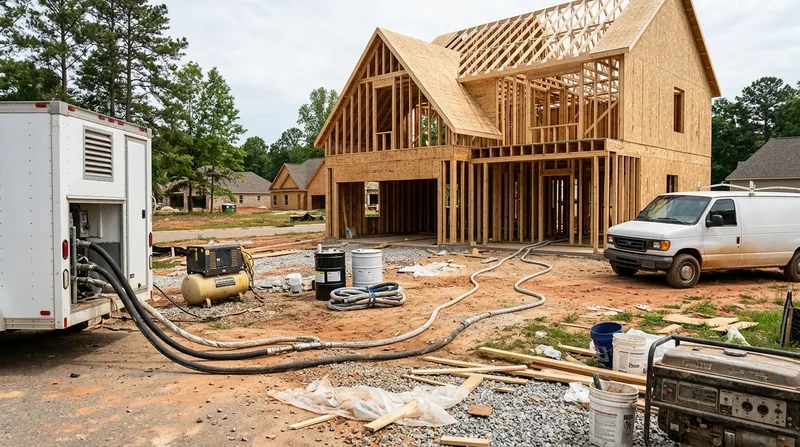




Commercial & New Construction Spray Foam in Columbus is planned in from the design stage, not added as an afterthought. Columbus sits in IECC climate zone 3A, where hot humid summers push moisture inward through most of the year, and new construction that ignores this reality pays for it in energy bills and moisture control problems for decades. North side subdivisions built around Fort Moore growth run newer slab foundations with conventional vented attics and long duct runs that fight attic temperatures through the cooling season. Metal buildings and commercial shells across Muscogee and Harris counties sweat and condense without closed-cell protection. Whether you are framing a new home, a metal building, or a commercial shell in Columbus or LaGrange, spray foam insulation and air sealing built in from day one cuts energy waste, eliminates damp crawl spaces, and controls the interior environment from the start. We work with builders to specify the right foam type, thickness, and air sealing strategy for your project and your climate.
Why Spray Foam Insulation Matters for New Construction in Columbus
Columbus builders face a specific challenge: the combination of hot attics and humid outdoor air creates pressure that conventional insulation cannot handle. Vented attics in the Chattahoochee Valley heat up to 140 to 160 degrees in summer while ductwork sits exposed. Crawl spaces over red clay pull in damp air through vented openings, leaving floor systems cold and clammy. Spray foam, sealed and installed correctly, stops both failure modes. New construction is the time to get it right, because retrofitting later costs twice as much and disrupts occupied space.
- Closed-cell foam stops humid air from entering wall cavities, rim joists, and crawl spaces before it condenses.
- Sealed attics and roof decks eliminate the hot-attic problem that drives cooling bills through the summer.
- Open-cell foam in interior walls and sound-sensitive areas offers lower cost and acoustic dampening without the moisture barrier.
- Air sealing around penetrations, rim joists, and band joists stops the leakage that insulation alone cannot fix.
- Proper installation with controlled thickness and mechanical ventilation during cure meets code and avoids the odor and off-gassing issues that mark poor work.
Builders who specify spray foam in the framing stage avoid costly change orders and moisture callbacks.
Key info: A new metal building in Harris County without closed-cell foam on the roof deck will sweat and drip condensation on equipment and inventory for years. Sealed foam installed during construction costs far less than dehumidification, corrosion repair, or product loss after move-in.
For more on how spray foam handles the moisture and thermal load specific to metal buildings, see our metal building and barndominium spray foam page.
How We Approach Commercial and New Construction Spray Foam in Columbus
We work with builders and general contractors from design phase through final inspection. The process starts with understanding your building type, climate exposure, and code requirements at your address. Columbus and surrounding areas have different permitting and thermal barrier rules depending on the city and building official, so we verify what applies before we quote. We then specify foam type, thickness in inches, R-value per the code, and mechanical ventilation during cure. On site, we control spray temperature, drum pressure, and application rate to hit the target thickness and density on every pass. After cure, we verify the work and provide documentation for your builder and building department.
- We review plans and specifications to identify all cavities, rim joists, crawl spaces, and roof deck areas that need foam.
- We coordinate with framing crews to spray before drywall or decking closes off access.
- We install closed-cell or open-cell foam to the thickness and R-value required by the energy code and the building official.
- We seal all rim joists, band joists, and rim board areas to stop air leakage and moisture intrusion at the foundation.
- We provide written documentation with R-value, thickness, and installation date for your building permit file.
- We schedule mechanical ventilation during cure and specify a re-entry window of 24 to 48 hours before occupancy.
The result is a building envelope that controls temperature, humidity, and energy cost from day one.
Example: A new residential subdivision in Columbus framing 30 homes with vented attics and crawl spaces on red clay specified closed-cell foam in all rim joists, band joists, and crawl space rim board, plus sealed attics with open-cell foam. The builder avoided moisture callbacks, the homes passed inspection on the first submittal, and energy bills ran 20 to 30 percent lower than the builder's prior projects without foam.
See our crawl space spray foam insulation page for details on how we handle foundation areas in Columbus.
Spray Foam Methods for New Construction
| Approach | Description | Best for |
|---|---|---|
| Closed-Cell Spray Foam | High-density foam (3.5 to 3.8 lbs per cubic foot) with R-value of 6.0 to 6.5 per inch. Forms a moisture barrier and structural contribution. Typical thickness 1.5 to 2.5 inches. | Rim joists, band joists, crawl space rim board, metal building roof decks, wall cavities in humid climates. |
| Open-Cell Spray Foam | Low-density foam (0.5 to 1.5 lbs per cubic foot) with R-value of 3.5 to 3.7 per inch. Vapor-permeable, lower cost, sound-dampening. Typical thickness 5 to 7 inches for R-21 to R-25. | Interior walls, attic cavities in dry climates, bonus rooms, garage walls where sound control matters. |
| Sealed Attic | Spray foam applied to the interior of the roof deck (closed-cell or open-cell), creating an unvented attic. Ductwork and mechanical equipment stay inside the conditioned space. | New construction with bonus rooms, attic mechanical rooms, or long duct runs. Eliminates 140-degree attic heat in Columbus summer. |
| Injection Foam Retrofit | Low-pressure injection into existing wall cavities through small holes. Fills cavities without demolition. Used for infill or addition framing. | New additions to existing homes, new walls built against existing structures, retrofit of pre-1980 stock in new construction neighborhoods. |
Commercial and New Construction Spray Foam Cost in Columbus: What to Expect
Cost for new construction spray foam depends on the building type, the area to be sprayed, foam type, and required thickness. A new residential home in Columbus with spray foam in the rim joist, band joist, crawl space rim board, and sealed attic typically runs between $2,000 and $5,000 for materials and labor, depending on the footprint and whether the attic is fully sealed or partially foamed. A metal building or commercial shell is quoted by the board foot, which we measure on site. The pricing page shows typical ranges, but the most accurate way to understand cost for your specific project is a free commercial estimate. We respond within 24 hours at (706) 940-6925, and the estimate includes R-value, thickness, and a breakdown of what drives the final number.
Factors that move the cost up include:
- Building size and total board feet of foam required for the scope.
- Foam type: closed-cell costs more per board foot but requires less thickness; open-cell costs less but needs greater depth for the same R-value.
- Access difficulty: tight rim areas, high roof decks, or confined spaces add labor time.
- Mechanical ventilation during cure: required by code, adds time and equipment cost.
- Code-required thermal barrier or ignition barrier: adds material and labor for drywall or intumescent coating.
The best approach is to get estimates from at least two contractors so you can compare not just price but also R-value, thickness, warranty, and insurance verification. A price far below market with no R-value or thickness specification is a red flag.
What to Look for When Hiring a Spray Foam Contractor Near Me in Columbus
Choosing the right spray foam contractor is critical because the work is inside your building envelope and affects energy cost and moisture control for decades. You are looking for a local shop with local plates and local accountability, not a rig-and-run crew from out of state that sprays a job in an afternoon and disappears when the smell will not go away. Ask potential contractors for written estimates that include R-value per inch, thickness in inches, foam type, and mechanical ventilation details. Verify that they carry full insurance and ask to see the certificate. Ask for references from recent new construction projects in Columbus or nearby towns and call at least two to ask about odor, re-entry timing, and whether any issues came up after move-in.
Key questions to ask any contractor, including us:
- Can you provide a written estimate with R-value, thickness, and foam type specified?
- What is your re-entry window after spray, and how do you manage ventilation during cure?
- Do you carry full insurance, and can you provide a certificate of insurance for our builder?
- Can you provide references from new construction projects completed in the past 12 months?
- Who is responsible for pulling permits, and how do you coordinate with the building official?
- What is your workmanship warranty, and what does it cover?
For a free estimate on your new construction or commercial project, contact us here or call (706) 940-6925.
Commercial & New Construction Spray Foam in Columbus: Pricing Guide
| Service | Price | Details |
|---|---|---|
| Free commercial estimate | Free | Includes R-value, thickness, foam type, and scope breakdown. Response within 24 hours |
| Residential new construction (rim, band, crawl space, attic) | Starting at $2,000 | Depends on home footprint, foundation type, and whether attic is fully sealed or partial foam |
| Metal building or commercial shell | Quoted by board foot | Measured on site. Closed-cell typically 1.5 to 2.5 inches, open-cell 5 to 7 inches. Includes labor and ventilation |
| Sealed attic retrofit on new construction | Starting at $1,500 | Roof deck interior spray. Cost depends on attic area and whether bonus room or mechanical space is included |
| Travel and coordination | Included | No separate call-out or mileage fee within Columbus and surrounding service areas |
| Thermal or ignition barrier drywall | On estimate | Code-required in some jurisdictions. Cost depends on barrier type and area to be covered |
Indicative pricing, the exact cost depends on square footage, finish, and site access. Free personalized estimate within 24h at (706) 940-6925.


