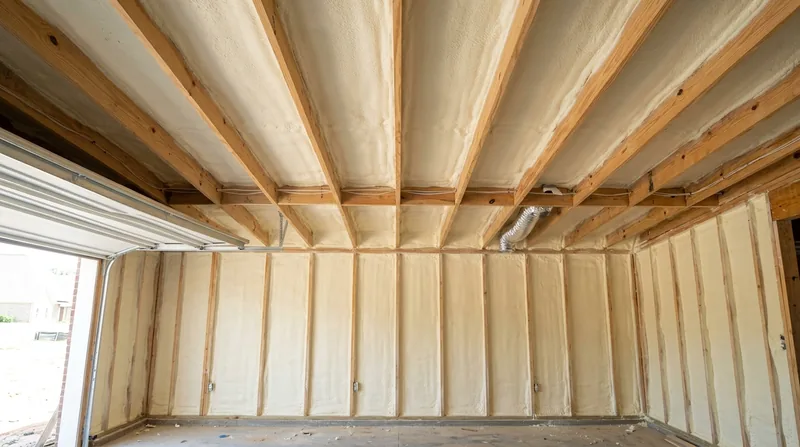




Garages in Columbus subdivisions often sit directly beneath bonus rooms, home offices, or secondary bedrooms that bake in summer heat for months on end. The long cooling season here, driven by hot humid air pushing against the Chattahoochee Valley climate, means an uninsulated or poorly insulated garage ceiling becomes a thermal liability that makes the room above uncomfortable and drives up air conditioning costs. Garage spray foam insulation in Columbus seals the garage ceiling and shared walls so that conditioned air stays where you need it, the room above stays livable through summer, and your cooling system does not fight a losing battle against heat radiating up from an open garage. We spray closed-cell or open-cell foam directly onto the garage ceiling and into the rim cavity between garage and living space, creating an air barrier and thermal break that conventional fiberglass batts simply cannot match. The result is a bonus room or master suite that stays comfortable without constant thermostat adjustment, and energy bills that reflect actual insulation rather than a patchwork of settled batts and air leaks.
Why Garage Insulation Matters in Columbus Heat
Columbus summers are long and humid, and garage spaces are notorious thermal bridges in homes built after the 1980s. A typical garage ceiling in a North side subdivision or Midtown neighborhood sits uninsulated or with a single layer of aging fiberglass, allowing radiant heat from the roof deck to transfer directly into the room above. The problem compounds when ductwork runs through the unconditioned garage or when the shared wall between garage and living space has no thermal break. Energy bills climb, homeowners crank the thermostat down, and the bonus room or master bedroom remains uncomfortable no matter what the setting.
- Uninsulated garage ceilings allow radiant heat to transfer directly into bonus rooms and second-floor bedrooms above.
- Sealed foam on the garage ceiling creates a thermal break that stops heat from radiating upward into conditioned space.
- The shared wall between garage and living space often lacks insulation, making that wall surface cold or hot depending on season.
- Foam on the shared wall and ceiling eliminates the air leakage path that lets conditioned air escape into the unconditioned garage.
- A properly insulated garage ceiling reduces the cooling load on your HVAC system and lowers monthly energy costs.
These improvements are especially critical in Columbus, where the combination of high summer heat and long cooling cycles makes every thermal barrier count.
Key info: A bonus room over an uninsulated garage in Columbus often runs 8 to 12 degrees hotter than adjacent rooms during summer. Sealing the ceiling and shared walls with spray foam typically brings that delta down to 2 to 3 degrees, putting the room back into the livable range without constant air conditioning adjustment.
How We Insulate Garage Ceilings and Shared Walls in Columbus
Our process starts with a site inspection to assess the garage ceiling condition, identify any moisture issues or air leakage paths, and determine whether the substrate is sound and dry. We then prepare the work area, establish ventilation to manage cure odor, and spray closed-cell or open-cell foam directly onto the garage ceiling and into the shared wall cavity. The foam expands and cures to a solid state, creating a monolithic air barrier and thermal break. We apply the foam to the specified thickness and R-value, and we document the job with a written estimate that names the R-value and thickness so you know exactly what was installed.
- We inspect the garage ceiling, shared walls, and rim joist area for moisture, existing damage, or air leakage paths before any foam is sprayed.
- We set up mechanical ventilation during the spray and cure phase to manage odor and ensure proper off-gassing.
- We spray closed-cell foam to create a high-R, moisture-resistant barrier, or open-cell foam for a lower-cost, sound-dampening option.
- We apply foam to the specified thickness in controlled passes, maintaining proper drum temperature and mix ratio throughout the job.
- We provide a written record of the R-value and thickness installed so you have documentation for energy efficiency claims or future reference.
The entire process typically takes one day for a standard garage, and you can re-enter the space within 24 to 48 hours after cure is complete. Our approach ensures the foam is installed correctly the first time, with no shortcuts and no off-gassing surprises weeks later.
Example: A 400-square-foot garage ceiling in a LaGrange subdivision received 2 inches of closed-cell spray foam, bringing the ceiling R-value to R-13. The shared wall between garage and bonus room received 1.5 inches of the same foam in the stud cavity. The bonus room temperature dropped from 88 degrees to 82 degrees during peak summer heat, eliminating the need for a portable air conditioner and cutting cooling runtime by roughly 20 percent.
Closed-Cell vs. Open-Cell Spray Foam for Garage Insulation
The choice between closed-cell and open-cell foam depends on your budget, moisture risk, and sound-dampening priorities. Closed-cell foam is denser, carries a higher R-value per inch (typically R-6 to R-6.5), and provides better moisture resistance, making it the better choice for garages where humidity or moisture ingress is a concern. Open-cell foam is lighter, less expensive, and offers superior sound dampening, making it a good fit for a garage that doubles as a workshop or hobby space where noise reduction matters.
| Foam Type | R-Value per Inch | Best Use in Columbus Garages |
|---|---|---|
| Closed-Cell Spray Foam | R-6 to R-6.5 | High-performance insulation, moisture resistance, garages with humidity risk or shared walls where thermal performance is critical. |
| Open-Cell Spray Foam | R-3.5 to R-3.8 | Budget-friendly option, sound dampening for workshop garages, lower R-value acceptable in bonus rooms where secondary insulation layers exist. |
| Blown-In Fiberglass (Top-Up) | R-2.2 to R-3.2 | Existing sound attic ceiling with partial insulation; not recommended for garage ceilings without a vapor barrier already in place. |
| Closed-Cell on Shared Wall Cavity | R-6 to R-6.5 | Fills stud cavity completely, creates air barrier, eliminates thermal short-circuit between garage and living space, highest performance option. |
For most Columbus garages with bonus rooms above, we recommend closed-cell foam on the ceiling and shared walls. The higher R-value means you need less thickness to hit your target R-value, and the moisture resistance protects against the humid conditions common in this climate zone. Open-cell can work in lower-risk scenarios or where budget is the primary driver, but closed-cell is the standard choice for performance and longevity in our climate. Visit our closed-cell spray foam insulation page for more technical details on closed-cell applications.
Garage Spray Foam Insulation Cost in Columbus: What to Expect
Garage ceiling and shared wall insulation in Columbus typically starts at $1,200 for a standard single-car garage with a straightforward ceiling and one shared wall. The final cost depends on several concrete factors: the square footage of ceiling to be foamed, the thickness and R-value target, whether you are insulating the shared wall as well, and the accessibility of the work area. A two-car garage or a garage with complex geometry (vaulted ceiling, multiple shared walls, or rim joist work) will cost more. If the garage has moisture issues or the existing ceiling needs repair before foam can be applied, that work will add to the total.
We provide written estimates with R-value and thickness specifications so you know exactly what you are paying for and what you will receive. The estimate is free and comes with no obligation to book. We recommend getting 2 to 3 estimates from local contractors so you can compare scope, materials, and price. Beware of estimates that do not specify R-value or thickness, or that promise work at a price far below market without a site visit first. Those are markers of a contractor cutting corners or planning to skip critical steps like mechanical ventilation during cure or proper thickness control.
For a detailed pricing breakdown across all our services, visit our full pricing page. Call us at (706) 940-6925 for a free estimate on your specific garage.
What to Look for When Hiring a Spray Foam Insulation Contractor Near Columbus
The spray foam insulation trade attracts both local independents and out-of-state rig-and-run crews. The difference matters. A local contractor with a local address and local plates is reachable after the job is done, maintains relationships in the community, and has skin in the game if something goes wrong. An out-of-state crew sprays in an afternoon, loads up the trailer, and is gone. When the smell does not clear on schedule or a problem appears weeks later, you have no recourse.
Here are the key things to verify when you call any spray foam contractor, including us:
- Ask whether the contractor is fully insured and request a certificate of insurance that names your address as an additional insured.
- Request a written estimate that specifies the R-value and thickness of foam to be installed, not just a total price.
- Ask about mechanical ventilation during the spray and cure phase, and what re-entry window the contractor guarantees (24 to 48 hours is standard).
- Call references from recent jobs in Columbus or nearby areas, and ask whether the foam cured on schedule and whether any odor issues arose after re-entry.
- Verify that the contractor has worked in your specific neighborhood or subdivision, so they understand local code requirements and any HOA rules that may apply to exterior work.
- Confirm that the contractor will inspect the substrate for moisture, existing damage, or air leakage before any foam is applied, and that they will walk away if the surface is not suitable.
Columbus Spray Foam Insulation has been operating locally since 2016. We are fully insured, and we provide written estimates with R-value and thickness specs on every job. We set up mechanical ventilation on every spray, and we document the work so you have a record of what was installed. To schedule your free estimate, contact us online or call (706) 940-6925.
Garage Spray Foam Insulation in Columbus: Pricing Guide
| Service | Price | Details |
|---|---|---|
| Single-car garage ceiling | Starting at $1,200 | Standard 300 to 350 square feet, closed-cell foam, 2-inch thickness, includes shared wall if applicable |
| Two-car garage ceiling and shared walls | Starting at $2,000 | 600 to 700 square feet, closed-cell foam, 2-inch thickness on ceiling and walls, rim joist included |
| Shared wall only (thermal break) | Starting at $600 | Stud cavity fill between garage and living space, 1.5 to 2 inches closed-cell foam, eliminates air leakage path |
| Open-cell option (budget-friendly) | Starting at $800 | Single-car garage ceiling, lower R-value per inch, sound dampening benefit, ideal for workshop or hobby space |
| Moisture remediation or substrate prep | On estimate | If garage ceiling or walls show moisture, active leaks, or existing damage, site inspection required before pricing |
| Free estimate | No charge | Response within 24 hours at (706) 940-6925, written quote with R-value and thickness, no obligation to book |
Indicative pricing, the exact cost depends on square footage, finish, and site access. Free personalized estimate within 24h at (706) 940-6925.


