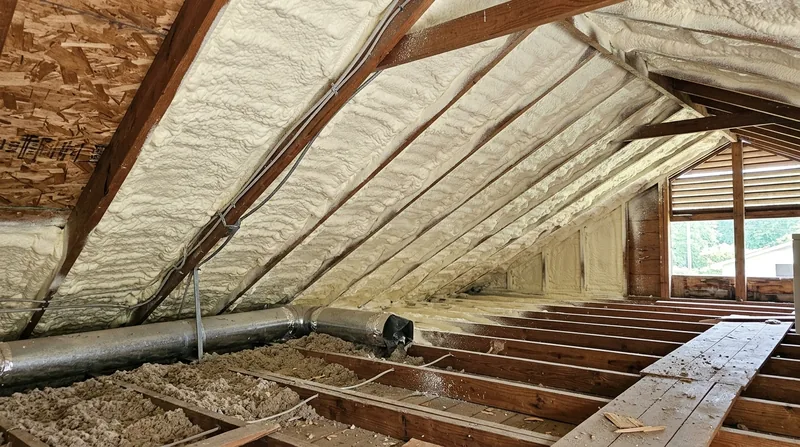




Attic spray foam insulation in Columbus stops summer heat from cooking your roof deck and keeps ductwork out of the humid Chattahoochee Valley air. Columbus sits in IECC climate zone 3A, where hot, humid summers push moisture inward through most of the year. Mid-century ranch homes across Midtown, Wynnton, and Lakebottom often carry settled fiberglass that has gone flat, leaving roof decks exposed to 130-degree heat and ductwork sweating in the attic. Newer subdivisions north of Fort Moore run conventional vented attics over long duct runs that fight summer cooling all season. We seal the roof deck from inside and fill the rafter bays with closed-cell or open-cell foam so your insulation and ducts stay protected from heat and humidity. The result is lower cooling bills, a drier attic, and equipment that runs cooler.
Why Attic Spray Foam Insulation Matters in Columbus' Hot, Humid Climate
Columbus attics face a dual challenge: extreme summer heat from above and moisture-laden air pushed upward from the humid valley floor. Fiberglass batts and blown-in insulation settle and compress over time, leaving gaps at the roof deck where heat penetrates directly into the living space. Vented attics pull damp outside air across ductwork and insulation, reducing their effectiveness and creating condensation on metal ducts and framing. Spray foam seals the entire roof deck and fills every rafter bay, eliminating the air leakage that drives energy loss and moisture problems.
- We seal all gaps and penetrations at the roof deck so outside heat cannot bypass your insulation layer.
- Closed-cell foam creates an air-tight, moisture-resistant barrier that protects ductwork from summer humidity.
- Filled rafter bays eliminate the convection currents that move hot air through vented attics.
- A properly sealed attic reduces the workload on your air conditioning system throughout the cooling season.
These measures are especially critical in Columbus, where the combination of intense summer heat and persistent humidity from the Chattahoochee River basin makes attic ventilation work against you, not for you.
Key info: Georgia building code requires a thermal barrier (fifteen-minute rated material) between spray foam and the living space in most residential attics. This is different from an ignition barrier and is the rule most installers misstate. Always verify what applies at your address with the City of Columbus Building Department or your local jurisdiction before work begins.
For more detail on the foam types that work best in Columbus, see our guide to closed-cell spray foam insulation and how it compares to open-cell options.
How We Seal and Insulate Your Columbus Attic: Step by Step
Attic spray foam starts with a thorough inspection. We identify all air leaks, measure the existing insulation, check for moisture or damage, and confirm that the roof deck and framing are sound. If old insulation is in the way, we remove it and haul it off. Once the space is clear and dry, we seal penetrations, rim joists, and ductwork connections with foam, then fill the rafter bays to the R-value your home needs. Mechanical ventilation runs during application and cure to manage fumes, and we post a re-entry window of 24 to 48 hours before the space is safe to occupy.
- We perform a detailed site inspection to assess attic condition, existing insulation, and any moisture or structural issues.
- We remove failed or settled insulation and dispose of it responsibly off-site.
- We seal all penetrations, ductwork connections, and rim joists before foam application begins.
- We apply foam at the correct thickness per pass and maintain proper equipment temperature and ratio throughout.
- We run mechanical ventilation during cure and provide a written re-entry window so your family stays safe.
- We provide a written estimate that specifies the R-value and thickness we will achieve.
This systematic approach prevents the common failures that plague attic foam work: shortcuts on ventilation, incorrect foam ratio, undersized thickness, and no clear re-entry guidance.
Local example: A 1970s ranch in Columbus' Wynnton neighborhood had 4 inches of settled fiberglass and exposed ductwork running 80 degrees in July. We removed the old insulation, sealed all roof penetrations and duct connections, and sprayed 5.5 inches of closed-cell foam into the rafter bays, achieving R-38. The homeowner reported cooler upstairs bedrooms within the first week and a measurable drop in cooling run time by month two.
For more on how air sealing complements foam insulation, visit our air sealing service page.
Attic Spray Foam Insulation Methods: Closed-Cell vs. Open-Cell
| Approach | Description | Best for |
|---|---|---|
| Closed-Cell Spray Foam | High-density foam (1.5 to 2 lbs/cu ft) with closed cellular structure. Provides R-6 to R-7 per inch, acts as an air and moisture barrier, and hardens within hours. | Columbus' hot, humid climate where moisture control and air sealing are critical. Sealed attics, rim joists, and metal buildings where condensation risk is high. |
| Open-Cell Spray Foam | Low-density foam (0.4 to 0.5 lbs/cu ft) with open cellular structure. Provides R-3.5 to R-4 per inch, allows some vapor permeability, and is less expensive per board foot. | Attics where insulation depth is not constrained, sound dampening is desired, and the roof deck is already protected. Requires proper ventilation or a secondary air barrier. |
| Partial Closed-Cell Seal | Closed-cell applied to the roof deck and rim joists only (1 to 2 inches), then open-cell or blown-in used to fill the rest of the rafter bay. | Balancing cost and performance in Columbus attics where the primary moisture threat is at the roof line and rim joists, not throughout the entire cavity. |
| Blown-In Insulation Top-Up | Dense-packed cellulose or fiberglass added over existing sound insulation without removal. Does not seal air leaks or provide moisture protection. | Only when existing attic insulation is intact, properly ventilated, and has no moisture history. Rarely the right answer in Columbus' climate. |
In Columbus' hot, humid climate, closed-cell foam is the standard choice because it stops both heat and moisture at the roof deck. Open-cell works in specific cases where depth is available and the roof is already protected. We'll recommend the right method for your home's condition and your budget during the free estimate.
Attic Spray Foam Insulation Cost in Columbus: What to Expect
Attic spray foam insulation in Columbus typically starts at $1.50 per square foot for a basic sealed attic with open-cell foam and standard roof access. Closed-cell foam, which is the better choice in Columbus' humid climate, costs more per board foot but requires less thickness to achieve the same R-value. The final cost depends on several factors: the size of the attic, the depth and condition of existing insulation, whether removal is needed, the complexity of the roof deck, access difficulty, and the R-value target. A 1,500 square-foot attic with moderate existing insulation and straightforward access might run $2,000 to $3,500 for closed-cell, while a smaller attic or one with open-cell foam could cost $1,200 to $2,000.
The smartest approach is to get written estimates from 2 to 3 contractors. Each estimate should specify the R-value you will receive, the foam thickness per pass, the coverage area, and any removal or prep work included. Avoid any estimate that omits R-value and thickness, quotes a price far below market, or promises immediate re-entry without a cure window. These are markers of corner-cutting that will leave you with poor performance, odor problems, and no recourse.
Travel is included in Columbus and surrounding areas with no separate mileage fee. We provide a free estimate within 24 hours at (706) 940-6925 with no obligation to book. For a detailed pricing overview and examples, visit our full pricing page.
What to Look for When Hiring a Spray Foam Insulation Contractor Near Me in Columbus
Hiring a spray foam contractor is a significant decision because poor installation creates odor, health concerns, and wasted money. The right contractor is fully insured, provides written estimates with R-value and thickness, runs mechanical ventilation during application, specifies a clear re-entry window, and stands behind the work with a straightforward warranty. You should always verify any contractor's insurance before work begins and ask for a certificate of insurance. Request references from recent jobs in Columbus and call them. Check whether the contractor understands local building code, especially the thermal barrier rule for attics, and confirm they will work with the local building department on permits if your project requires them.
- Confirm the contractor is fully insured with current coverage and ask to see the certificate before scheduling.
- Request a written estimate that names the R-value, thickness per pass, coverage area, and any removal or prep included.
- Ask for at least two references from homes or businesses in Columbus where they have completed attic foam work in the past year.
- Verify they understand Columbus building code thermal barrier requirements and will help navigate permitting if needed.
- Confirm they run mechanical ventilation during application and provide a written re-entry window of 24 to 48 hours.
- Ask about their workmanship warranty and whether they can provide documentation of the foam system they use.
A contractor who rushes the estimate, avoids naming R-value, or promises immediate occupancy is not the one to hire. The local independent shop with a local address and crew is typically more accountable than a rig-and-run outfit from out of state or a national franchise that cannot reach you when questions arise after the job. Contact us for a free estimate and to discuss your attic's specific needs at our contact page.
Attic Spray Foam Insulation in Columbus: Pricing Guide
| Service | Price | Details |
|---|---|---|
| Open-cell spray foam attic, standard access | Starting at $1.50/sq ft | Covers attic sealing and rafter bay fill; cost rises with attic size, existing insulation removal, and roof deck complexity |
| Closed-cell spray foam attic, sealed deck | Starting at $2.50/sq ft | Preferred in Columbus humidity; higher R-value per inch; cost depends on attic square footage, access difficulty, and removal scope |
| Partial closed-cell (seal only) plus top-up | Starting at $2.00/sq ft | Closed-cell applied to roof deck and rim joists, open-cell or blown-in for cavity fill; balances cost and moisture control for Columbus climate |
| Insulation removal and haul-off | Starting at $0.75/sq ft | Cost depends on insulation type, volume, accessibility, and whether contamination testing is required before disposal |
| Estimate and site inspection | Free | Response within 24 hours at (706) 940-6925; no obligation; written estimate includes R-value, thickness, and coverage specifications |
Indicative pricing, the exact cost depends on square footage, finish, and site access. Free personalized estimate within 24h at (706) 940-6925.


